When nothing happens
Take your time.
Things can carry on much as before, while our place within them changes completely.
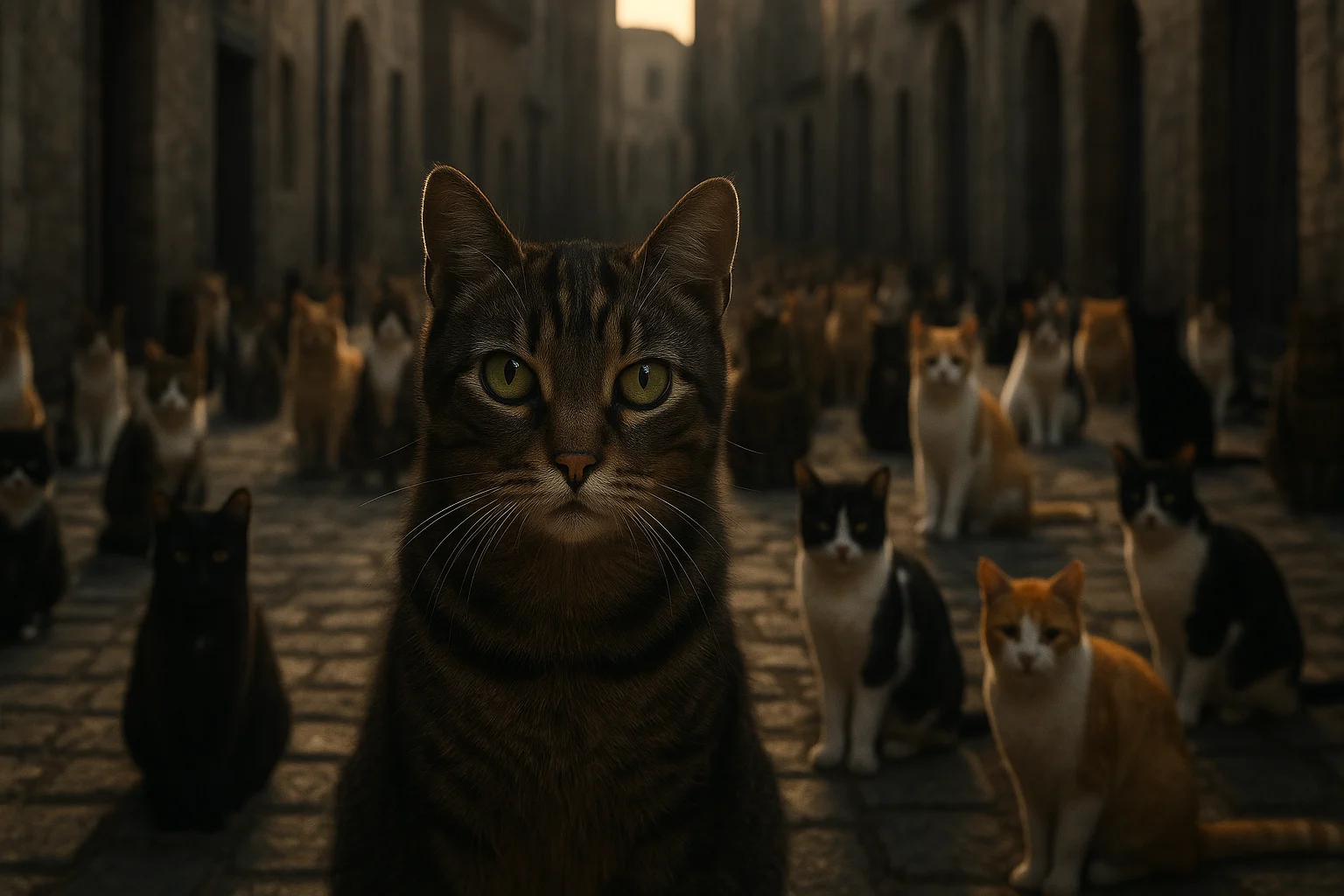
I found myself drawn back to one of my favourite books, 1Q84 by Haruki Murakami, and a strange, mesmerising story tucked inside it: Town of Cats.
A young man travelling by train gets off at a small town. In daylight, it seems deserted. But as evening falls, giant cats arrive, and begin going about distinctly human business: opening shops, working, eating and drinking.
He hides in a bell tower and watches them. The town has its own routines, its own working life, and he is fascinated. Trains stop during the day, but he chooses to stay and observe.
Eventually, the cats sense him. They can smell a human presence, and they search for him. Yet even when they reach his hiding place, they cannot see him.
That is enough. He decides to leave.
But when the morning train arrives, it passes straight through the station. The next train does the same. He realises they will never stop for him again.
The town carries on. The trains keep to their tracks. What has changed is his place within it all.
That, for me, is the unsettling part.
We tend to recognise change through events: an announcement, a decision, a confrontation. Something visible that divides before from after. But here, the same activity continues, and its meaning for one person has altered completely. The train is still running. It simply no longer offers him a way home.
A system can maintain its familiar patterns while our relationship with it changes.
This connects with something I’ve explored in other posts: the ‘immune responses’ of organisations. Someone introduces a different perspective, challenges an assumption, or begins working in an unfamiliar way. The response may be subtle. Their input gets redirected. Their influence diminishes. They find themselves further from the conversations where things happen.
The organisation continues. Work gets done. Meetings take place. From the perspective of maintaining its established patterns, things may even feel more settled.
From the individual’s perspective, something significant has been lost.
Organisational cybernetics gives us a way of thinking about that difference. Stafford Beer’s Viable System Model asks how a system maintains its identity and remains viable amid change. But the continuing viability of an organisation tells us very little, by itself, about the experience of a particular person within it.
An arrangement can keep functioning while someone loses their voice, their connection, or their room to act.
I don’t think Murakami’s town maps neatly onto an organisation. The cats cannot even see their visitor, despite sensing that he is there. But that makes the image more unsettling: being present in a system, affected by its routines, yet somehow outside what it can recognise.
And I’m interested in how easily we might miss that shift.
If the familiar routines continue, we can assume that our relationship with them continues too. We still have the same role, the same meetings, the same surroundings. We expect the same possibilities to remain available.
Until we try to use one.
The unanswered request. The contribution that no longer carries weight. The conversation we discover has already happened elsewhere. Any one of these may mean very little. Together, they can reveal a change we hadn’t recognised.
That makes ‘nothing happens’ a more difficult observation than it first appears.
Nothing happens to whom? What are we looking at when we decide that things haven’t changed? The organisation’s output? Its routines? Our own ability to participate?
And what happens when I turn that question back on myself? When I’m pleased that a team has settled into a new way of working, have people found a rhythm that serves them? Or have some simply stopped trying to influence it?
The quieter meeting might reflect trust. It might also reflect resignation. The surface can look much the same.
There is still value in waiting, witnessing and allowing things to develop. I don’t want to lose that. But paying attention means looking beyond whether the system is still moving, and noticing what participation in it has become possible.
The trains are running.
Do they still stop for us?