There’s certain ideas and themes that I keep coming back to in my favourite books and studies and conversations – questions about authenticity, influence, time, and the mix of strengths and flaws that make us human. And perhaps unsurprisingly, there’s a lot of overlap between these ideas and my exploration of systems thinking – looking at the world in a way that considers interconnections, unintended consequences, and the general complex messiness of life.
Like the rest of the blog site I’m writing this mostly for myself, as a place to capture these thoughts and explore how they all connect. I’m not entirely sure where all this leads, but having a space to explore these ideas is helpful and grounding.
Big theme 1 – Self vs. society

There’s this ongoing tension between being true to oneself and blending into the world around us. It’s a balance – trying not to lose who you are whilst recognising that everyone you meet has their own stories, their own ways of seeing. Where fave author Becky Chambers (A Psalm for the Wild-Built) simply puts it as “You are allowed to just live”, it’s a simple, grounding, reminder that being yourself doesn’t need to come with justification.
Systems thinking talks about pluralism – recognising that everyone has their own (constantly shifting) experiences and perspectives – and boundaries – where we all see the world from our own ‘situation of interest’ within a larger story. I think that’s something worth holding on to: finding ways to be genuine while acknowledging that others will approach life on their own terms.
Big theme 2 – Power and responsibility

Power and responsibility are inevitably intertwined. Any time we try to change something, it reflects back on us too. Adrian Tchaikovsky (Cage of Souls) says “We must be careful what we become when we seek to change things. An old principle of physics: if you push, you yourself are pushed in turn.” It’s a reminder to think carefully about influence – not only because of what it does to others but because it subtly reflects back to shape who we become.
There’s a ripple effect in everything we do; every action sparks reactions we might not see coming. Systems thinking would describe this in terms of feedback loops – continuous effects that circle back – and unintended consequences. It can be tough trying to keep an eye on all the moving parts in the big picture. Maybe we should be trying to plant better values and more thoughtful changes at a more fundamental level, knowing then that the ripples will carry these values out more widely across the system, even if we can’t quite predict how.
Big theme 3 – Time and change

Time is the most powerful unstoppable force. It has its own flow no matter how much we might try to influence it. A favourite line from Ursula K. Le (The Dispossessed): “The future will arise spontaneously out of all these things”. This is systems thinking’s concept of emergence – the natural patterns of behaviour that arise from independently acting parts within a larger system or society. If you ever played Conway’s Game of Life (maybe in the 1980’s on a BBC home computer?) you’ll know what I mean!
Systems thinking also acknowledges entropy – the tendency for systems to become more disordered over time, especially without intervention. I like the idea of time just doing its thing – planting seeds and allowing them to evolve naturally, rather than forcing outcomes. Seeing things emerge that you didn’t plan for. Perhaps there’s wisdom in stepping back and just allowing nature to take its course.
Big theme 4 – Human nature
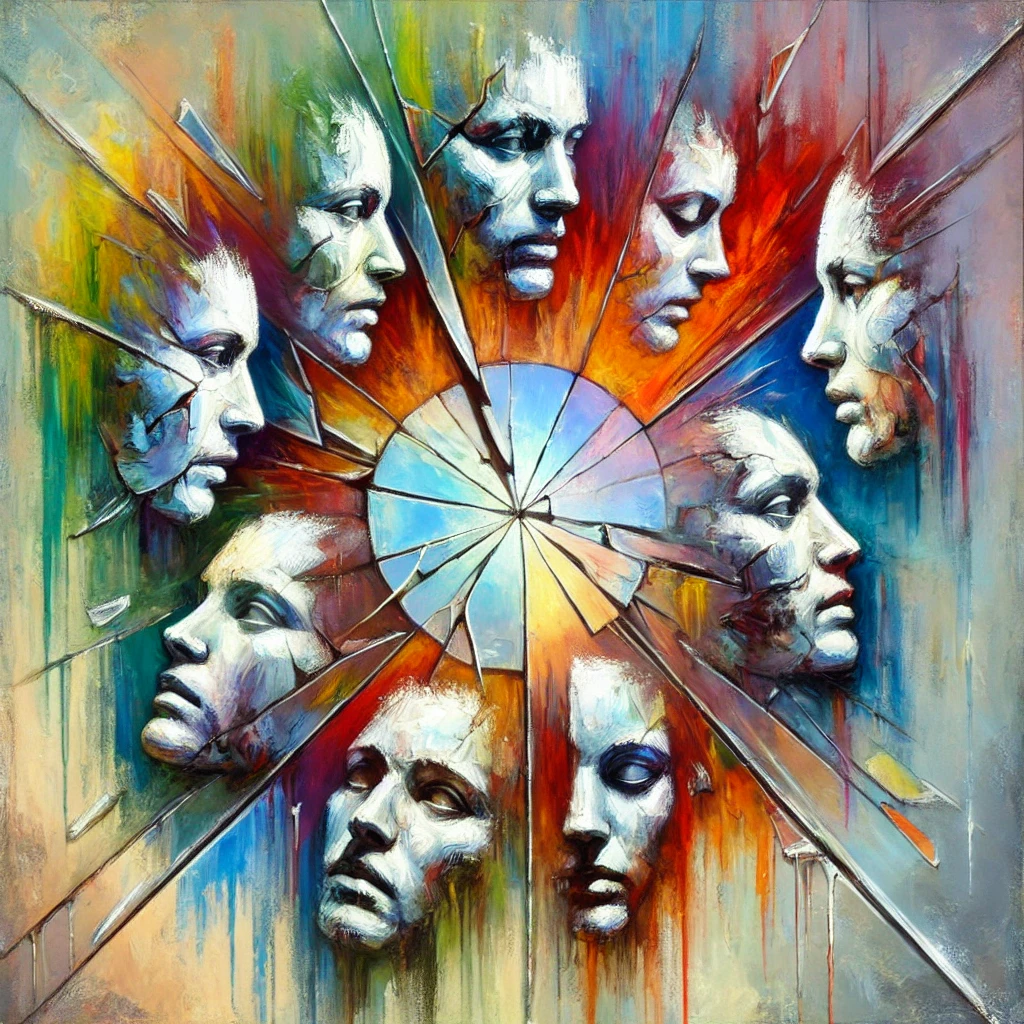
Human nature – messy, contradictory, and filled with flaws and a need for compassion.
Systems thinking places great importance on understanding how our individual perspectives, biases, and blind spots influence how we interpret and respond to any situation, and how collectively this diversity enriches our understanding rather than contradicts it.
Emily St. John Mandel (The Glass Hotel) adds “One of our signature flaws as a species: we will risk almost anything to avoid looking stupid”. Funny but accurate as a reflection of how vulnerable and proud and sometimes self-destructive and short-sighted we can be.
And yet it’s those very flaws that make us human. They add depth to the whole; the pieces all come together to make our full and unique identities. You have to embrace all of it, or none of it.
These themes – Self vs. Society, Power and Responsibility, Time and Change, and Human Nature – aren’t just abstract ideas. They’re threads that run through our everyday lives, shaping how we navigate the world and connect with ourselves and others. Reflecting on them isn’t about finding answers but about deepening our understanding of the questions themselves.
So, whether you’re pondering your place in society, grappling with responsibility, feeling the pull of time, or embracing your human imperfections, I hope these thoughts resonate with your own journey. After all, it’s through reflection and connection that we make sense of the complexities of life – and maybe even find a little clarity and inner balance along the way.
 K Shel Blogs