Maybe the work isn’t always to provoke change. Maybe sometimes it’s enough to bear witness – to notice, to reflect, and to remain open to what hasn’t yet arrived.
I found myself drawn back recently into one of my favourite books (by one of my favourite authors) – 1Q84 by Haruki Murakami – and in particular, a strange and mesmerising vignette tucked inside it: Town of Cats.
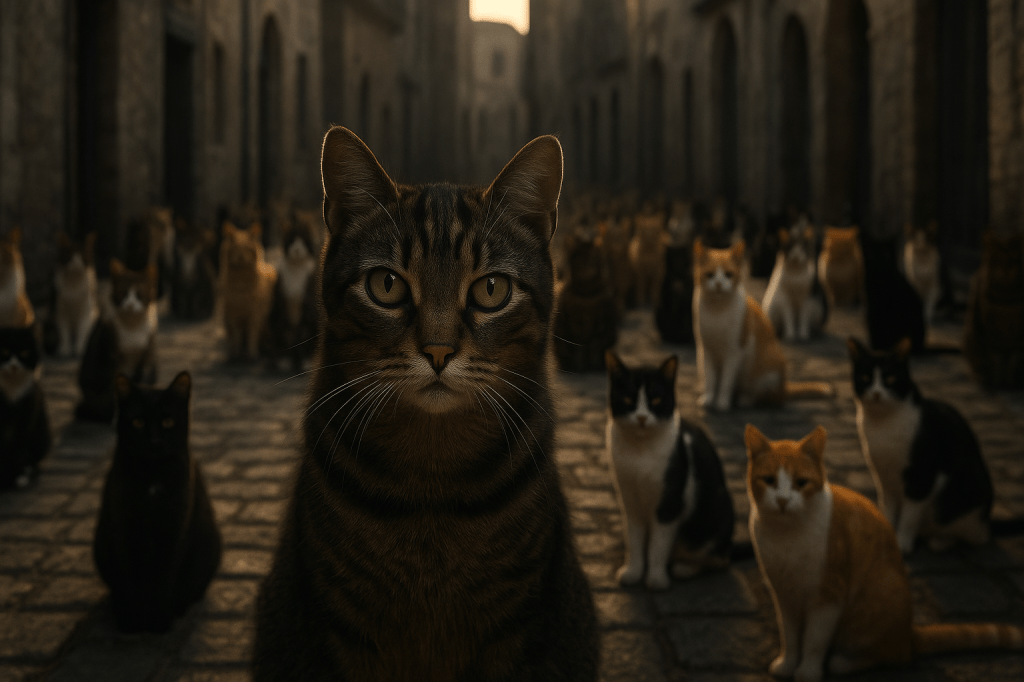
The story is short, dreamlike, and – on the surface – simple. A man travels by train, disembarks in an unfamiliar place, and wanders into a seemingly abandoned town. It’s unnaturally quiet, immaculately clean. He explores the empty streets, buys lunch from a vendor who vanishes, and watches the light begin to shift. At dusk, the cats arrive.
They move through the town with quiet purpose, going about their business as if it were entirely normal for cats to inhabit a place like this. They don’t speak or confront him – they simply gather. He’s been warned not to stay the night, but he does. And dozens, perhaps hundreds, of cats appear and fix their gaze on him.
There’s a rising tension, a sense that something is about to happen. The scene builds like a crescendo – not explosive, but gravitational – as if the man is on the cusp of some profound transformation. The setting feels mythic, symbolic, otherworldly. You hold your breath, waiting for the shift.
But it never comes.
The next morning, the man leaves. The story ends.
That absence stayed with me. Not because it was disappointing, but because it felt intentional. It’s not a weak ending – it’s a withheld one. The transformation remains implied but unrealised. It lingers as potential. Nothing more.
And maybe that’s the point. The transformation is with the reader, not the actor.
That subtle shift reminded me of something I’ve been sitting with lately: what we do with change that doesn’t arrive. I’ve been working with ideas about how outcomes emerge – often gradually, unpredictably, without ceremony. Sometimes there is no plan. Sometimes nothing happens, and yet something shifts.
Town of Cats doesn’t just ask us to observe what’s changing. It quietly urges us to attend to what isn’t.
That sounds simple, but it runs counter to how we’re often trained to think – in business, in policy, in personal growth. We’re taught to track motion: what moved, what improved, what transformed. Stillness is mistaken for failure. If nothing happened, we assume nothing mattered.
But what if we asked different questions?
- What patterns are repeating?
- What’s resisting movement?
- What’s being said in the silence?
- What didn’t happen – and why might that matter?
Seen through that lens, Town of Cats becomes more than a surreal detour. It becomes a metaphor for the systems we live in – or become part of – where transformation is expected, but not guaranteed. Where resolution is withheld. Where significance lies not in outcomes, but in our experience of waiting for them.
The man doesn’t transform into a cat. (I was 100% expecting him to transform into a cat). But we, as readers, are changed by the expectation that some big transformation is coming. And by the discomfort of its absence. That’s the mirror. The story reflects us back to ourselves – our assumptions about norms and story arcs and what change should look like, and what it means when it doesn’t arrive on cue.
This ‘when nothing happens’ stance is not passive. It’s an active kind of noticing – a tuning in to the quiet parts of the system. The moments that resist action. The pause that wasn’t planned. The energy that holds rather than shifts.
Sometimes what looks like non-change is a system protecting itself. Or preparing. Or pausing. And that pause might be the most revealing thing it does.
Where we often talk about learning as you go, this is learning in the waiting. In the inertia. In the thing that didn’t move.
It’s harder to see. Harder to measure. But no less real.
So when you think about transformation – in any part of your life – try not to rush it. Try not to assume that change is always visible, always linear, always immediate. Sometimes the most important shifts happen beneath the surface, or not at all.
And sometimes, the outcome is what doesn’t happen when you stay overnight in the town of cats.


 K Shel Blogs