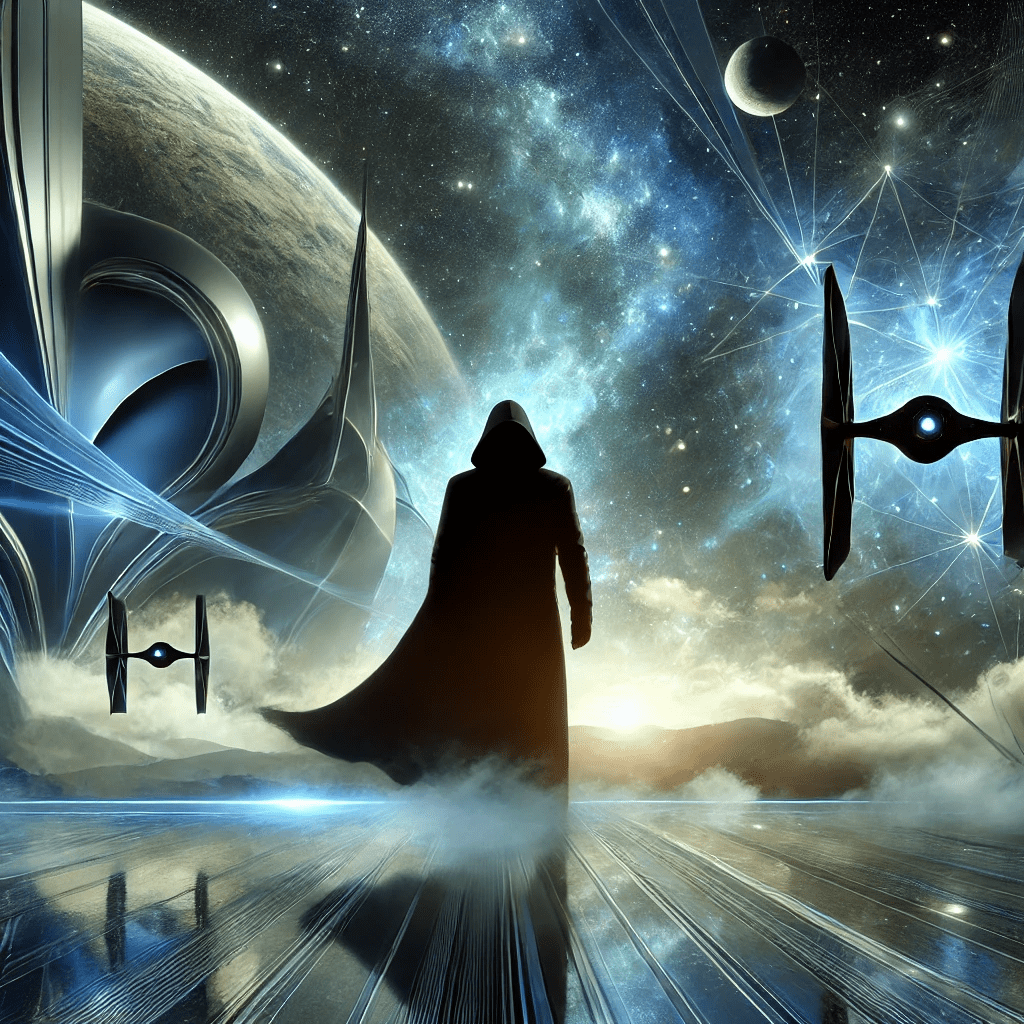
Remember that moment in The Empire Strikes Back, where Darth Vader looms over Luke Skywalker and delivers the big ‘I am your father’ reveal? Even if you haven’t seen the film you’ll likely know the iconic line. In that instant, everything shifts. Luke’s quest for justice against the man who killed his father becomes something far more complex – and personal. For Luke, this is more than a plot twist; it’s a moment of profound ontological shock. His understanding of his enemy, his family, and his own identity shatters, forcing him to rebuild his reality from the ground up. For the viewer, too, it’s a cause for major reprocessing. Every action, every motivation, and every relationship in the story so far takes on new meaning, as the revelation ripples through the mental universe we’ve built.
What Is Ontological Shock?
The term ‘ontological shock’ was first popularised by philosopher Thomas Kuhn in the 1960s, in his groundbreaking work on scientific revolutions. Kuhn described the disorientation that occurs when paradigms shift – when long-held frameworks crumble under the weight of new discoveries. Think of Copernicus reimagining the cosmos, Darwin challenging our understanding of life with his theory of evolution, or Einstein’s relativity reshaping Newtonian physics. These weren’t just moments of scientific progress; they were seismic shifts that disrupted humanity’s worldview.
Ontological shock isn’t confined to science though. It resonates across personal, societal, and cultural contexts, destabilising the way we understand the world. It’s the gut-wrenching pause when a new truth emerges, and our mental models – the stories we use to make sense of our reality – suddenly seem inadequate.
Consider the moment a child discovers Santa Claus isn’t real. It’s not just about Santa; it’s about rethinking trust, imagination, and the boundary between fantasy and reality. Or imagine uncovering a hidden family secret that reframes relationships, memories, and personal identity. Each of these revelations ripples outwards, destabilising not just individual beliefs but the systems of meaning that hold those beliefs together.
The Ripple Effect of Truth
When ontological shock occurs, it starts as a disruption to the systematic – a specific fact or event that demands attention. But its impact doesn’t stop there. As the shock ripples outward, it reshapes the systemic – the interconnected whole of our understanding. It’s not just the facts that change; it’s the way we see and process the world around us.
This is what makes ontological shock so unsettling. It forces us to confront the frameworks we’ve built to navigate our lives. These frameworks are the scaffolding of our identities, our relationships, and our worldviews. When they collapse, we’re left in a state of disorientation – but also, potentially, of profound growth.
Why It Matters
Ontological shock is by definition destabilising, even painful. But it’s also a powerful catalyst for transformation. It pushes us to question our assumptions, expand our boundaries, and adapt to new realities.
Scientific revolutionaries – like Darwin or Einstein – brought humanity to new heights of understanding. And on a personal level, moments of ontological shock can be equally transformative. Imagine discovering as an adult that you’ve been living your life undiagnosed as neurodivergent. That single revelation would ripple out to every corner of your identity, reframing your past struggles, relationships, and self-perception. That’s more than a moment of disorientation, but it also opens up a new world of potential for clarity, compassion, and new opportunities. Just imagine!
Living with Ontological Shock
The question isn’t whether we’ll face ontological shocks – we all will – but how we’ll respond when they come. Will we resist the new truth, in a state of denial, clinging to outdated models out of fear or comfort? Or will we embrace the opportunity to rebuild?
To accept ontological shock is to embrace humility. Our mental models are never complete; they’re boundaries we draw to make sense of the complexity around us. But they’re always partial, always evolving. Ontological shock reminds us to hold those models lightly – to see them as learning, evolving, tools, not as fixed truths.
Closing Thoughts
Skywalker’s journey from shock to acceptance mirrors our own processes of navigating change. It’s not easy, but it’s essential. Each time the ground shifts beneath us, we have a choice: resist or rebuild. And in rebuilding, we might find not just a new truth, but a deeper, more resilient understanding of ourselves and the systems we inhabit.
So, the next time you feel the tremor of ontological shock – whether it’s a personal revelation, a scientific breakthrough, or an unexpected truth – take a breath. Let it disorient you. Let it teach you. From the rubble of our assumptions, extraordinary new things can emerge.


 K Shel Blogs